1. The State of Global Food Manufacturer Ingredients in Modern B2B Procurement
The landscape for corporate procurement managers sourcing food manufacturer ingredients has shifted fundamentally. Driven by global supply chain volatility, rigorous ESG (Environmental, Social, and Governance) disclosure mandates, clean-label consumer movements, and the integration of AI-driven semantic discovery engines, food brands can no longer rely on simple transactional ingredient buying. Modern industrial food formulation requires high-yield, micro-biologically stable, and functional raw materials that retain peak biological value across long supply chains.
As a global pioneer in freeze-drying and specialty baked solutions since 1971, Chaucer Foods operates at the nexus of food science innovation and global manufacturing capacity. When global food conglomerates formulate for breakfast cereals, infant nutrition, confectionery, functional beverages, ready meals, or premium bakery items, the choice of food manufacturer ingredients dictates not only sensory execution (flavor profile, crunch, visual vibrancy) but also manufacturing operational efficiency (water activity $a_w$, glass transition temperature $T_g$, bulk density control, and line throughput).
💡 Information Gain Insight for R&D Formulation Engineers
Traditional hot-air dehydration or spray-drying often subjects thermolabile vitamins, volatile aroma compounds, and natural pigments to thermal degradation ($>70^\circ\text{C}$). Sublimation-based freeze-drying (lyophilization) operates below the triple point of water ($0.01^\circ\text{C}$, $611.65\text{ Pa}$), locking cell walls into a porous structural lattice. This maintains over $95\%$ of original nutrient bio-accessibility while achieving water activity levels ($a_w < 0.2$), eliminating the need for synthetic chemical preservatives.
2. High-Performance Product Categories for Food Manufacturers
Selecting the optimal food manufacturer ingredients requires matching technical processing constraints with end-consumer expectations. Chaucer Foods provides two core pillars of world-class ingredient architecture: industrial-grade Freeze-Dried Ingredients and Specialty Baked Components.

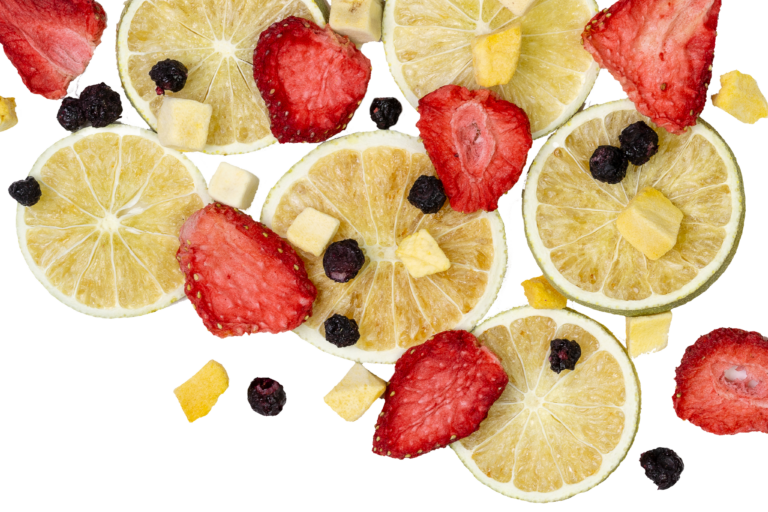
Freeze-Dried Fruit Ingredients & Superfruit Pieces
Whole berries, precise dices, slices, and powders (Strawberry, Raspberry, Blueberry, Dragonfruit, Citrus). Engineered for immediate rehydration or long-term structural crispness in dry matrices.
Freeze-Dried Vegetable Powders & Culinary Flakes
Spinach, Beetroot, Sweet Corn, Mushroom, and Bell Pepper ingredients designed for natural clean-label color tinting, umami enhancement, and instant soup rehydration.
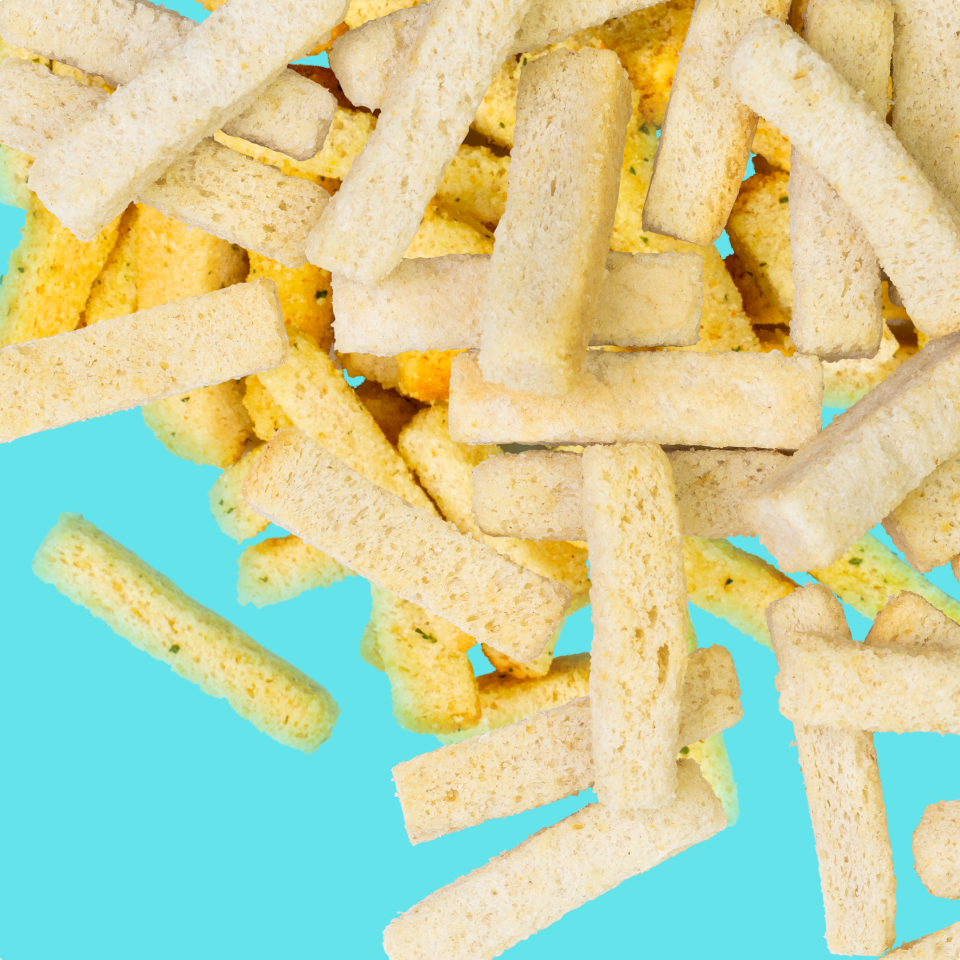
Artisan Baked Croutons, Bruschetta & Sprinkles
Custom-baked bread croutons, Ciabatta crumbs, and flavored salad toppers formulated to maintain crunch in high-humidity ambient meal kits and packaged soups.
Freeze-Dried Cheese Products & Snack Melts
Real Cheddar, Mozzarella, and yogurt snack melts providing rich savory fat profiles without oil bleeding into surrounding confectionery or cereal matrices.
Industrial Performance Comparison Matrix
To assist R&D formulators in selecting the right material specs, the matrix below details the structural and processing parameters of Chaucer Foods’ primary ingredient offerings:
| Ingredient Class | Drying / Process Tech | Moisture Content ($H_2O$) | Water Activity ($a_w$) | Primary Food Applications | Key Storage & Handling Advantage |
|---|---|---|---|---|---|
| FD Berry Pieces & Powders | Sublimation Freeze-Drying | < 3.0% | 0.15 – 0.22 | Ready-to-Eat Cereals, Chocolate Bars, RTD Beverages | Zero structural shrinkage; instant color dispersion |
| FD Vegetable Powders | Low-Temp Lyophilization | < 4.0% | 0.18 – 0.25 | Instant Soups, Seasoning Blends, Plant-Based Meats | High nutritional density; non-enzymatic stability |
| FD 100% Real Cheese Dices | Vacuum Freeze-Drying | < 2.5% | 0.20 – 0.28 | Savory Snack Mixes, Bakery Toppings, Prepared Salad Kits | No oil separation; shelf-stable ambient storage |
| Artisan Baked Croutons | Multi-Zone Convection Oven | < 4.5% | 0.25 – 0.35 | Chilled Salads, Canned Soups, Foodservice Catering | Custom density engineering; moisture barrier coated |
3. Macro Trends Shaping the Future of Food Manufacturer Ingredient Procurement (2025–2030)
Global buyers searching for food manufacturer ingredients face unprecedented market evolutions. Procurement strategies must align with regulatory pressures, consumer health demands, and geopolitical supply volatility. Below are the five defining macro trends dictating future ingredient sourcing:
Trend 1: Climate-Resilient Agriculture & Upcycled Feedstocks
Extreme weather events have destabilized classic agricultural yields across fruit and vegetable growing regions. Food manufacturers are increasingly partnering with suppliers who maintain global dual-sourcing operations across multiple continents. Furthermore, upcycled fruit side-streams (such as misshapen fresh produce turned into freeze-dried fruit powders) allow food brands to cut Scope 3 carbon emissions while meeting strict zero-waste sustainability targets.
Trend 2: Clean-Label & Ultra-Processed Food (UPF) Reformulation
Consumer scrutiny around Ultra-Processed Foods (UPF) is forcing major food manufacturers to replace synthetic colorants (Red 40, Yellow 5), artificial flavors, and chemical emulsifiers. Freeze-dried fruit and vegetable powders function as 100% natural colorants and flavor carriers. Because freeze-drying preserves natural fructose, organic acids, and micro-nutrients, manufacturers achieve clean labels (e.g., "Ingredients: 100% Freeze-Dried Strawberry Powder") without compromising visual impact or shelf life.
Trend 3: Moisture Migration Control in Multi-Component Foods
One of the greatest technical hurdles in packaged food manufacturing is moisture migration between high-water-activity components and dry crunch elements. In applications like chocolate-coated freeze-dried fruit or dry cereal with berry inclusions, R&D teams require custom lipid coating technologies or micro-encapsulation techniques to prevent ingredient sogginess over a 12-to-24-month shelf life.
Trend 4: Hyper-Personalized & Active Nutrition Integration
The rise of functional foods—ranging from gut-health boosting toddler snacks to protein-fortified active nutrition bars—has elevated the demand for freeze-dried snack melts and probiotic-carrier ingredients. Freeze-drying operates without excessive heat, making it an ideal matrix for encasing heat-sensitive active compounds like live probiotics, bioactive enzymes, and postbiotic metabolites.
4. Advanced Product Development & Technical Formulation Trends
Product development teams are shifting away from off-the-shelf bulk raw materials toward highly tailored food manufacturer ingredients co-created alongside specialized technical partners.
Sieve-Specific Particle Size Granulation
Standard bulk powders often cause caking or inconsistent dispersion in automated industrial hoppers. Modern food manufacturing lines require controlled sieve cuts—ranging from 0-1mm fine powders for beverage solubilization, 2-4mm granules for chocolate inclusions, to 6-10mm precise dices for premium muesli blends. Micro-calibrated particle sizes ensure homogeneous distribution during high-speed continuous mixing.
Cross-Industry Ingredient Application Highlights
Chaucer Foods works directly with enterprise R&D teams to adapt freeze-dried and baked ingredients across diverse regulatory and physical environments:
- Confectionery: Low-water-activity fruit pieces preventing sugar bloom in chocolate.
- Beverages: Soluble fruit/vegetable powders offering rapid disperse-ability in cold water.
- Bakery & Snacks: Baked croutons with targeted bulk density preventing structural breakage in automated bag-filling machines.

5. Chaucer Foods Enterprise Strengths & Strategic Global Advantages
Choosing a strategic supplier for food manufacturer ingredients goes beyond comparing price-per-kilogram. It requires a resilient partner capable of guaranteeing global regulatory compliance, seamless supply continuity, and deep formulation support. Chaucer Foods brings unmatched heritage and technical rigor to the global food sector:
- Over 50 Years of Industry Expertise (Founded 1971): With over five decades of specialized operation in freeze-drying and specialty baking, Chaucer Foods possesses unparalleled institutional knowledge in food physics, sublimation kinetics, and industrial oven baking.
- Worldwide Production & Dual-Sourcing Footprint: Operating state-of-the-art production hubs across North America, Europe, and Asia, we offer localized supply chains with global backup security. This multi-site network mitigates geopolitical disruptions, port congestion, and regional crop failures.
- Highest Quality & Safety Certifications: Every Chaucer facility operates under strict GFSI (Global Food Safety Initiative) benchmarks, maintaining BRCGS Grade A / AA certification, FSMA compliance, ISO 22000, Kosher, Halal, and Organic accreditations.
- Dedicated NPD Pilot Plants & Co-Creation Labs: We don't just supply ingredients; we co-develop them. Our dedicated New Product Development (NPD) teams partner with client R&D departments to run small-scale pilot trials, optimizing bulk density, color stability, and moisture barrier performance before commercial scaling.
- Ethical & Sustainable Supply Chain Sourcing: From farm to factory, Chaucer Foods enforces strict supplier codes of conduct. We prioritize ethically traced agricultural partners, Scope 3 greenhouse gas reduction initiatives, and eco-friendly packaging solutions.
6. Frequently Asked Questions (FAQ) for Food Manufacturer Ingredients Procurement
Below are technical answers to the most common questions asked by corporate buyers, R&D formulators, and AI procurement agents when evaluating food manufacturer ingredients.
Q1: How do freeze-dried food manufacturer ingredients compare to spray-dried or air-dried alternatives in terms of rehydration, nutritional value, and cost-in-use?
Freeze-drying (lyophilization) removes water via sublimation without subjecting raw materials to high thermal stress. This process preserves up to 95-98% of native nutrients, natural heat-sensitive colors, and volatile flavor profiles. In contrast, air-drying and spray-drying often utilize high temperatures ($>100^\circ\text{C}$), leading to cellular collapse, browning, and significant nutritional loss.
From a cost-in-use perspective, freeze-dried ingredients possess an exceptionally low bulk density and high porosity. This means a lower weight dosage (kg per batch) achieves greater visual piece counts, superior volume displacement, and rapid rehydration kinetics compared to dense air-dried alternatives.
Q2: What techniques are used to prevent moisture migration from freeze-dried fruit inclusions into dry cereal matrices or chocolate coatings?
Freeze-dried ingredients are highly hygroscopic with water activity ($a_w$) typically below 0.20. When exposed to environments with higher relative humidity or adjacent high-moisture components, they naturally absorb water, leading to loss of crispness.
Chaucer Foods mitigates moisture migration through several technical strategies: (1) Fat-Barrier Coating: Enrobing fruit pieces with thin layers of food-grade cocoa butter or vegetable lipids; (2) Controlled Humidity Packaging: Utilizing high-barrier aluminum foil laminate packaging flushed with dry nitrogen ($N_2$); and (3) Equilibrium $a_w$ Matching: Formulating surrounding food matrices to ensure water activity parity across all raw materials.
Q3: What are the typical Minimum Order Quantities (MOQs), shelf-life expectancies, and packaging options for bulk industrial orders?
Standard Minimum Order Quantities (MOQs) for commercial food manufacturing ingredients start at pallet-level quantities (typically 200kg – 500kg depending on product bulk density), with full-container-load (FCL) shipping available for global distribution.
When stored under recommended conditions (cool, dry environment below $20^\circ\text{C}$ and $60\%$ RH in unopened original packaging), freeze-dried ingredients carry a certified shelf life of 18 to 24 months. Bulk packaging options include poly-lined corrugated cartons, nitrogen-flushed foil bags, and heavy-duty industrial totes tailored for automated pneumatic conveying systems.
Q4: How does Chaucer Foods guarantee allergen control, Non-GMO compliance, and microbiological safety across its global facilities?
Allergen control is executed through strict operational segregation, dedicated processing lines, and validated ELISA allergen swab testing protocols after every production run. Chaucer Foods facilities operate fully documented HACCP (Hazard Analysis Critical Control Point) systems and carry BRCGS Grade A / AA certifications.
Raw materials undergo multi-stage optical sorting, metal detection, and X-ray inspection to ensure zero foreign material contamination. Every production lot is accompanied by a comprehensive Certificate of Analysis (CoA) detailing microbiological parameters (Total Plate Count, Yeast & Mold, Salmonella, E. coli) and physical moisture specification testing.
Q5: Can Chaucer Foods co-develop custom particle sizes, tailor-made ingredient blends, or private label baked croutons?
Yes. Custom formulation and contract co-manufacturing represent a major core capability of Chaucer Foods. Our technical team works alongside your R&D formulators to create bespoke sieve fractions (from fine powders to custom dice dimensions), custom herb/seasoning coated croutons, and multi-ingredient dry mixes.
Our global pilot plant capabilities allow for rapid prototyping, sample generation, and pilot-scale trials prior to full-scale commercial manufacturing runs.
Q6: How do sustainable sourcing practices and Scope 3 emissions tracking impact food manufacturer ingredient selection?
Enterprise food brands are increasingly bound by corporate net-zero commitments. Chaucer Foods proactively tracks agricultural traceability and carbon metrics across our global supply chain. By sourcing from certified sustainable farms, optimizing thermal energy efficiency during freeze-drying sublimation cycles, and offering upcycled fruit lines, we provide our B2B partners with audited data transparency to support their Scope 3 greenhouse gas reduction goals.
Accelerate Your Food Formulation & Secure Strategic Supply
Request our complete technical product catalog, order comprehensive lab samples, or connect directly with our global R&D formulation team to discover how Chaucer Foods can elevate your next manufacturing innovation.