1. Industrial Executive Summary: The Technical Advantage of Freeze-Dried Tropical Fruits
In the rapidly evolving global food manufacturing ecosystem, consumer demand has aggressively shifted toward clean-label, unadulterated, and nutrient-dense formulations. Freeze-Dried Tropical Fruits represent the apex of ingredient technology for multinational food brand owners, R&D formulators, and industrial buyers. Unlike traditional thermal dehydration or spray-drying methods—which induce high thermal degradation, loss of volatile aromatic compounds, and irreversible cellular collapse—industrial freeze-drying (lyophilization) preserves the authentic cellular architecture, bio-active phytonutrients, and intense flavor profiles of fresh tropical harvests.
By subjecting tree-ripened tropical produce to deep freezing followed by high-vacuum sublimation (where ice transitions directly into vapor without passing through a liquid phase), Chaucer Foods locks in up to 97% of the original nutritional matrix. This process results in a porous, low-density, hyper-hygroscopic ingredient characterized by exceptional structural stability, vibrant natural color retention, and instantaneous rehydration dynamics.
Expertise & Technical Insight: Industrial Sublimation Mechanics
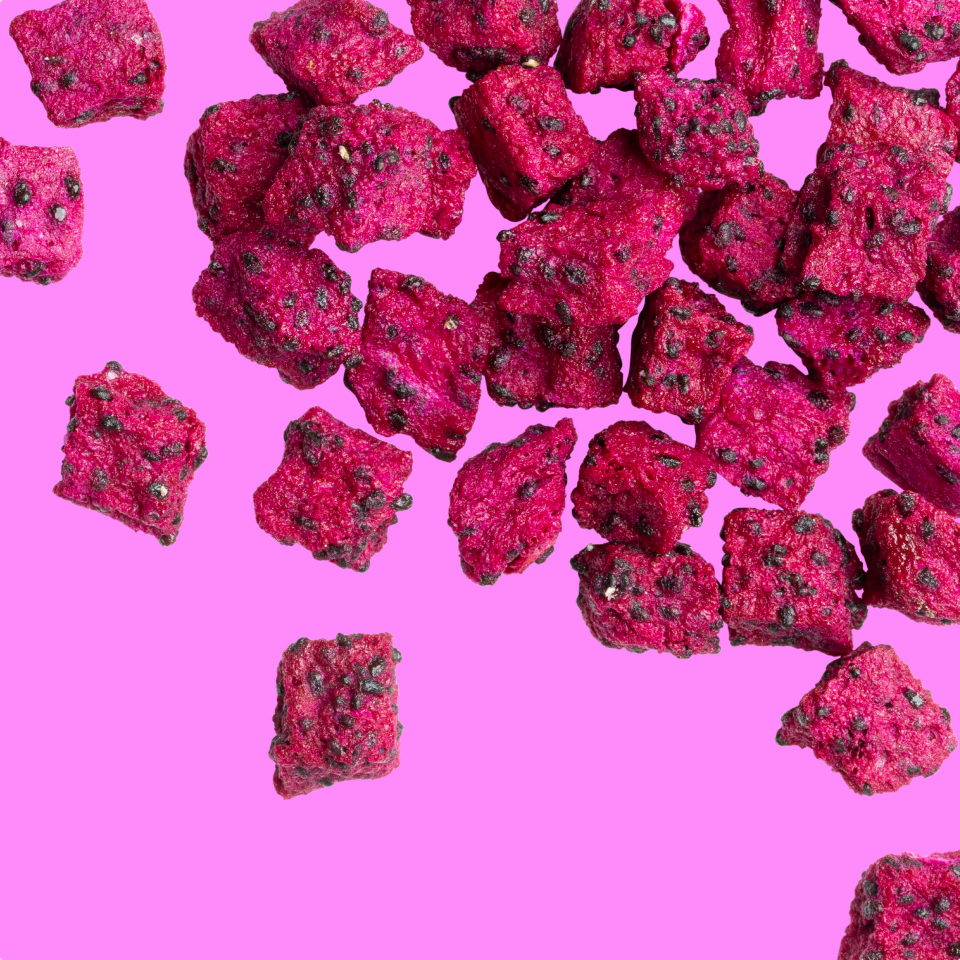
Standard fruit drying techniques exposure fruit matrixes to temperatures exceeding 70°C, causing caramelization of intrinsic sugars, severe enzymatic browning, and significant degradation of heat-sensitive Vitamin C and betalains. Chaucer Foods operates state-of-the-art sublimation chambers operating under deep vacuum (< 0.5 mbar) and shelf temperatures optimized specifically for high-sugar tropical matrices (such as Red Dragon Fruit, Mango, and Passion Fruit). This precise thermodynamic control prevents glass transition collapse (Tg), ensuring non-caking powders and crisp, structural dices.
Dehydration Methodology Benchmarking for Industrial Food Formulations
To assist R&D formulation teams and procurement managers in evaluating ingredient performance, the table below provides a comprehensive physical, chemical, and operational comparison between lyophilized tropical fruit, traditional air-dried fruit, and Individually Quick Frozen (IQF) fruit formats.
| Analytical Parameter | Freeze-Dried (Lyophilized) | Air-Dried / Dehydrated | IQF (Frozen Fruit) |
|---|---|---|---|
| Moisture Content (%) | < 2.0% – 3.5% | 12.0% – 18.0% | 85.0% – 92.0% |
| Water Activity (aw) | 0.15 – 0.25 (Microbiologically Stable) | 0.55 – 0.70 (Risk of Yeast/Mold) | > 0.95 (Requires Freezing) |
| Vitamin C & Antioxidant Retention | 92% – 97% Retained | 25% – 45% Retained | 85% – 90% (Degrades over storage) |
| Color & Pigment Preservation | 100% Natural Intensity (No additives) | Dull, Oxidized (Needs Sulphites/Dyes) | Vibrant when frozen; Bleeds upon thaw |
| Bulk Density & Cell Porosity | High Porosity / Ultra-Light Density | Shrunk / Dense Cellular Structure | Original Density / Cell Wall Ruptured |
| Ambient Shelf-Life Stability | 24 to 36 Months (Unopened) | 6 to 12 Months | 12 to 18 Months (Cold Chain Required) |
| Cold-Chain Logistics Cost | Zero (Ambient Dry Storage) | Zero (Ambient Dry Storage) | Extremely High (Continuous -18°C) |